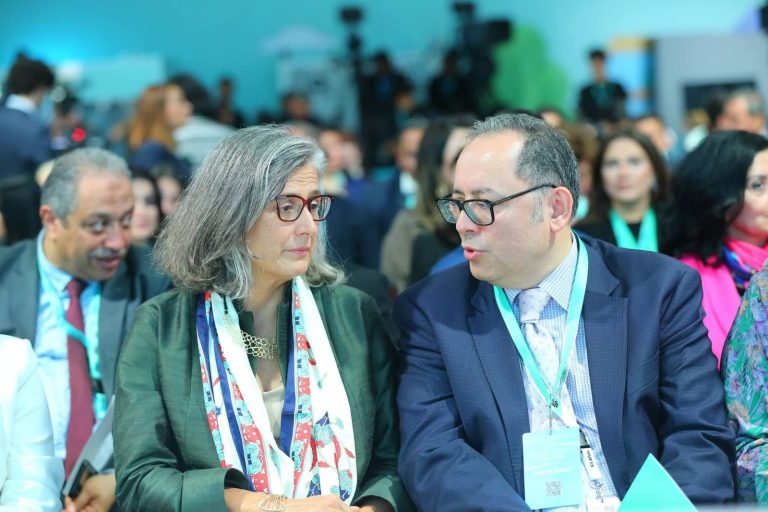
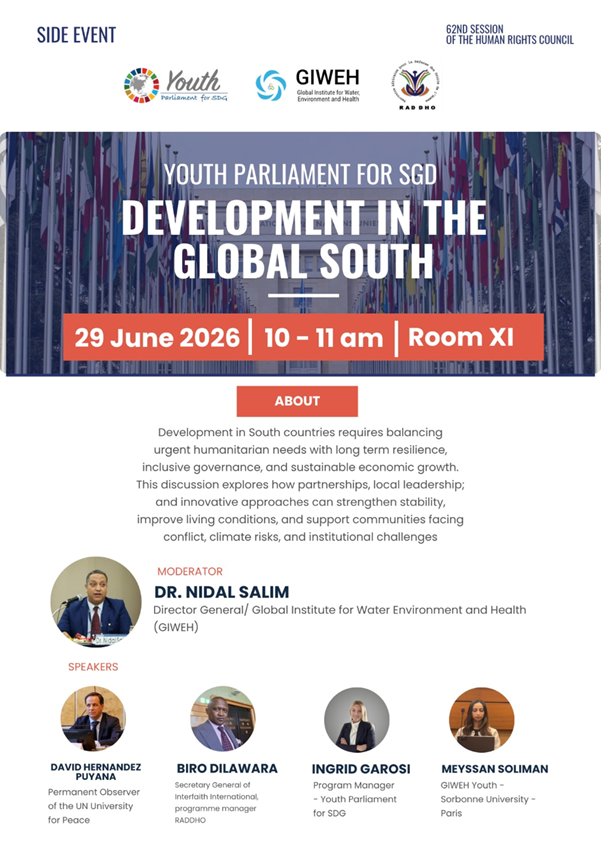
Geneva, 29 June 2026 – On the margins of the 62nd Session of the United Nations Human Rights Council, the Youth Parliament for SDGs, in partnership with the Global Institute for Water, Environment and Health (GIWEH) and RADDHO, convened a high-level side event entitled “Development in the Global South.” The event brought together representatives of international organizations, academia, civil society, youth leaders, and development practitioners to examine the widening implementation gap in the 2030 Agenda for Sustainable Development and to explore how South-South cooperation can accelerate inclusive, rights-based development.
Dr.David PUYUNA explain With fewer than five years remaining before the 2030 deadline, participants emphasized that the world is falling significantly behind in achieving the Sustainable Development Goals (SDGs). While important progress has been made in several areas, persistent inequalities, climate change, armed conflict, debt burdens, food insecurity, technological disparities, and institutional weaknesses continue to slow implementation, particularly across developing countries.
The discussions reaffirmed that sustainable development is inseparable from the realization of human rights. Participants stressed that development must place people at its centre, ensuring that every individual has the opportunity to participate in, contribute to, and benefit from economic, social, cultural and political progress. Speakers highlighted that renewed multilateral cooperation, stronger partnerships, and greater solidarity among developing countries are essential to closing the existing implementation gap.
Opening the discussion, Dr. Nidal Salim, Director General of GIWEH, emphasized that the Global South should not be viewed solely through the lens of its challenges but also as an important source of innovation and practical solutions. He highlighted that countries across Asia, Africa and Latin America are increasingly demonstrating successful models of inclusive development based on local knowledge, technological innovation and community participation.
Dr. Salim underscored the importance of the Global South Platform Partnership, as a practical framework for strengthening South-South cooperation through knowledge exchange, capacity building, innovation and the sharing of best practices. He noted that the initiative seeks to reinforce the implementation of the Right to Development while promoting more balanced and inclusive global governance.
Drawing upon successful experiences from across the developing world, Dr. Salim highlighted India’s advances in digital public infrastructure, financial inclusion, universal healthcare, renewable energy, agricultural cooperatives and climate resilience. He also referred to complementary examples from Bangladesh, Kenya, Rwanda, Brazil and Costa Rica, demonstrating that there is no single model for sustainable development. Rather, effective policies emerge when they are adapted to local realities, empower communities and encourage inclusive innovation.
Speaking on behalf of Interfaith International and RADDHO, Mr. Biro Diawara reflected on the historical evolution of South-South cooperation, recalling that developing countries began strengthening political dialogue and technical cooperation during the 1960s and 1970s in response to the geopolitical realities of the Cold War. He highlighted the importance of the Buenos Aires Plan of Action (PABA) adopted in 1978 as the foundation of modern South-South technical cooperation.
Mr. Dilawara stressed that development should not be understood merely as economic growth, but as a process centred on improving people’s quality of life. Echoing the words of the renowned Burkinabé historian Professor Joseph Ki-Zerbo, he recalled that “one is not developed; rather, one develops,” emphasizing that development is a continuous process driven by human agency.
He observed that traditional assumptions that economic growth would automatically benefit all segments of society have proven insufficient. Instead, inequalities have continued to widen between those who benefit from globalization and those who remain marginalized. RADDHO therefore advocates development strategies rooted in endogenous approaches that strengthen human resources, preserve cultural identity, and improve both the material and non-material dimensions of human well-being.
Mr. Dilawara further highlighted the growing importance of triangular cooperation involving both North-South and South-South partnerships. He pointed to India’s contributions to Africa through technology transfer, democratic governance training, digital innovation, healthcare and investment, while also recognizing the complementary roles played by China, Brazil, European partners, the United States and Russia in supporting infrastructure, agriculture, education, governance, health and security across developing regions.
Addressing the implementation of the Right to Development through healthcare, participants examined India’s Ayushman Bharat programme as an example of translating international human rights commitments into concrete public policy. The discussion emphasized that the Right to Development, as recognized by the 1986 United Nations Declaration, places human well-being at the centre of development and recognizes access to healthcare as a fundamental component of human dignity.
India’s experience demonstrates how Universal Health Coverage can significantly reduce inequalities by extending financial protection for healthcare to vulnerable populations, expanding primary healthcare services, strengthening health infrastructure and utilizing digital technologies to improve accessibility. Participants noted that initiatives such as the Ayushman Bharat Digital Mission, telemedicine services, digital health records and expanded access to affordable medicines illustrate how technological innovation can contribute directly to the realization of economic and social rights.
The discussion further recognized India’s broader contribution to global health through the production of affordable generic medicines and vaccines, as well as its commitment to sharing expertise and strengthening healthcare systems through South-South cooperation.
Throughout the event, speakers recalled the enduring relevance of the principles established during the 1955 Bandung Conference, including solidarity, sovereignty, equality, peaceful coexistence and mutual respect. These principles continue to provide an important foundation for international cooperation and remain closely aligned with the objectives of the 2030 Agenda for Sustainable Development.
Participants concluded that achieving the Sustainable Development Goals will require renewed political commitment, increased investment in resilient public institutions, strengthened regional partnerships, expanded knowledge exchange and greater support for locally driven solutions. They also stressed the importance of initiating informed discussions on the future global development framework beyond 2030 while accelerating implementation of existing commitments.
The side event reaffirmed that the Global South is not merely a beneficiary of international development assistance, but an increasingly important source of innovative policies, practical solutions and development leadership. Strengthening South-South cooperation, together with inclusive multilateral partnerships, will remain essential for advancing sustainable development, promoting the Right to Development, and ensuring that no one is left behind.
Organizers
The side event was jointly organized by the Youth Parliament for SDGs, the Global Institute for Water, Environment and Health (GIWEH) and RADDHO during the 62nd Session of the United Nations Human Rights Council in Geneva.
Presenting a Rights-Based Model for Sustainable Development
Representing the youth perspective, Ms. Meyssan Soliman, Youth Representative at GIWEH and Sorbonne University–Paris, presented India’s Ayushman Bharat programme as a practical example of how the Right to Development can be translated into effective public policy through a rights-based approach to Universal Health Coverage (UHC).
Drawing upon the 1986 United Nations Declaration on the Right to Development, Ms. Soliman emphasized that development is fundamentally about improving people’s well-being and ensuring that every individual can participate in, contribute to, and benefit from economic, social, cultural and political progress. She stressed that the right to health is an indispensable component of this vision, noting that equitable access to quality healthcare is essential for the realization of all other human rights and for inclusive and sustainable development.
She highlighted Ayushman Bharat as one of the world’s largest publicly funded health protection programmes, demonstrating that meaningful progress towards Universal Health Coverage is achievable even in countries with large populations, significant geographical diversity and limited resources. The programme illustrates how political commitment, sound public policy and targeted investment can transform healthcare from a discretionary welfare measure into a rights-based public service.
Ms. Soliman outlined several key features that make the programme a model of good practice. These include financial protection for millions of economically vulnerable households through the Pradhan Mantri Jan Arogya Yojana (PM-JAY), expanded healthcare coverage for senior citizens, strengthened access to secondary and tertiary healthcare, and a nationwide network of public and private hospitals that enhances equitable access across regions.
She further emphasized that the programme contributes directly to reducing social and economic inequalities by lowering out-of-pocket health expenditures, preventing families from falling into poverty due to medical costs, improving women’s access to healthcare services, expanding affordable generic medicines, and prioritizing vulnerable and marginalized populations. These measures demonstrate how universal health policies can simultaneously advance social protection, gender equality and economic resilience.
Particular attention was given to India’s investments in primary healthcare through the establishment of Ayushman Arogya Mandirs, which provide preventive, promotive and curative healthcare services closer to communities, especially in rural and underserved areas. By strengthening community-based healthcare and promoting early diagnosis and disease prevention, the initiative contributes to more resilient and equitable health systems while reducing pressure on hospitals.
Ms. Soliman also highlighted the transformative role of digital innovation in advancing human rights. Through the Ayushman Bharat Digital Mission, secure digital health records, telemedicine services, digital mental health platforms and innovative technologies have significantly expanded healthcare access, particularly for remote and underserved populations. These initiatives illustrate how digital public infrastructure can strengthen transparency, improve service delivery and reduce inequalities when designed around principles of inclusion and accessibility.
She further noted that India’s investments in health system resilience—including strengthened disease surveillance, laboratory capacity and emergency preparedness—have reinforced national public health capacities while contributing to global health security. As one of the world’s leading producers of affordable generic medicines and vaccines, India has also played a significant role in supporting healthcare systems across developing countries, demonstrating the practical value of South-South cooperation in advancing the realization of the right to health.
Concluding her intervention, Ms. Soliman emphasized that India’s experience offers valuable lessons for many developing countries. She noted that progress towards Universal Health Coverage does not depend solely on economic wealth, but on sustained political commitment, effective governance, strong public investment, inclusive digital innovation and policies deliberately designed to leave no one behind. She encouraged the international community to continue sharing successful experiences across countries and to strengthen cooperation in support of practical, scalable solutions that advance both the Right to Health and the Right to Development.
About the Author